Your product
5900 - Scratch / Mar attachments


5900 - Scratch / Mar attachments
Despite the similarity in the way scratches are created, there are numerous styli referred to in the test procedures. Taber offers a range of these interchangeable tools, but warns against comparing results obtained with different shaped styli. The shape of the stylus can affect the stress distribution when the stylus tip is moved over the material surface, as well as the frictional resistance.
Required accessories relevant ...
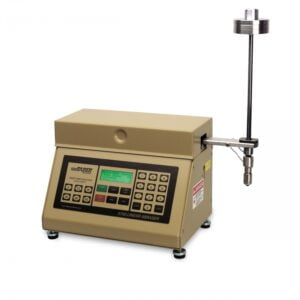
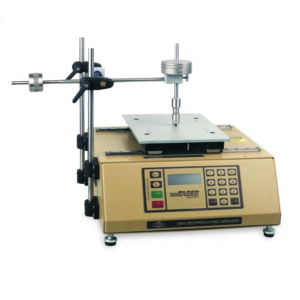
HINWEIS: Viele der linearen Kratz-/Mar-Aufsätze können auch mit dem Linear Abraser von Taber verwendet werden.
Regardless of the shape of the styli, it is important to monitor the wear of the stylus tips. Over time, the tips can become blunt, increasing the contact area of the tip and reducing the cutting action, making the tip less sensitive. Asymmetrical wear of the stylus tip can also occur, which can increase friction when scratching. And due to material differences in the test pieces, it is impossible to predict how long the tool will last. If you have access to optical measuring devices that provide ±0.01 mm and ±1° accuracy, you can monitor the wear of your scribing tools. Check the tool at certain intervals (e.g. every 250 or 500 attempts). If flattening or any other type of damage is detected, the scribing tool should be discarded and replaced with a new one.
Spherical tips (with thread)
Due to their symmetrical properties, spherical tips allow the stylus to touch the test surface without having to worry about orientation or alignment. Because of this property, spherical tips are the most commonly used shape for scratch testing.
Conical - These scraper tips consist of Tungsten carbidewhich is brazed onto a stainless steel body with a diameter of 0.375″. A #8-32UNC-2A grub screw allows this tip to be screwed directly onto the underside of the splined shaft of the Linear Abraser or the weight pin of the Reciprocating Abraser. All tips are equipped with a 60° angle.
- Conical scraper tip, 0.10 mm diameter
- Conical scraper tip, 0.25 mm diameter
- Conical scraper tip, 0.30 mm diameter
- Conical scraper tip, 0.40 mm diameter
- Conical scraper tip, 0.50 mm diameter
- Conical scraper tip, 0.60 mm diameter
- Conical scraper tip, 0.75 mm diameter
- Conical scraper tip, 1.00 mm diameter
Hemispherical - A tungsten carbide ball is brazed into a 0.375″ diameter stainless steel body. A threaded rod allows this tip to be attached directly to the underside of the Linear Abraser splined shaft or the Reciprocating Abraser weight bare screw. The tips with a diameter of 1.0 mm have an angle of 60° and the tips with a diameter of 7 mm have an angle of 75°.
- Tip with 1.0 mm diameter
- Tip with 7.0 mm diameter
Taber also offers a 1.0 mm diameter tip that contains a steel ball (HRC 60-66). Similar to the tungsten carbide tip described above, the steel ball tip has a 60° angle.
Diamond tool holder
Taber offers two industry-standard Diamond tools on. The diamond tip is conical and lapped onto a 0.092″ large and 0.531″ long stainless steel rod. The tools with a radius of 3 mil and 3.5 mil have a 90° angle, the tool with a radius of 0.3 mm has a 60° angle.
- 3 mil radius tip - Model 139-55
- 3.5 mil radius tip - Model 139-56
- Tip with 0.3 mm radius - Model 139-52
Both tools require one of the following accessories to hold the diamond tool securely.
The Diamond tool holder is a cylindrical holder into which the diamond tool is inserted and fixed with a set screw. A #8-32UNC-2A threaded tip makes it possible to screw this tip directly onto the underside of the splined shaft of the Linear Abraser or the weight column of the Reciprocating Abraser.
The Scratch Kit contains both diamond tools together with a 7x measuring magnifier. This attachment is available in steel [98g] or aluminium [33g] and is attached to the lower end of the Linear Abraser splined shaft or the Reciprocating Abraser weight post.
Multi-Mar rubbing attachment
The Multi-Mar scraper attachment is designed for four different styli and comes in a 45° or 90° alignment available. This attachment is generally used to test plastics, paints and coatings for their scratch and abrasion resistance.
Loop stylus (loop stylus) - Manufactured from 1″ long and 1/16″ diameter tool steel, heat treated to HRC 55-61, with an outside radius of 0.128″ and a surface finish of 8 RMS (included with every Multi-Mar scraper attachment).
Needle stylus (Needle Stylus) - Made of stainless steel with a tip diameter of 1.5 mm, a hardness of HRC 55-61 and a surface finish of 8 RMS.
Hoffman Type Stylus - Made from tool steel, heat-treated to HRC 55-61, with a contact arc of 0.275″ diameter and a surface finish of 8 RMS.
Standardised copper "coin" - Made from copper alloy 101, this coin has a diameter of 0.75″ and a thickness of 0.06″ with an edge radius of R0.010″. The hardness of this tool has been chosen to simulate the hardness of the human fingernail and allows for a repeatable "fingernail scratch" or coin scratch test. It is also useful for determining the durability of scratch-off applications used on lottery tickets and similar products.
Coin holder
The Coin holder attachment is available in three different angles and has a 0.078″ wide and 0.45″ deep slot. The standardised copper coin can be used with this holder as well as with other coins in circulation. [Note: Be careful when testing with a coin that has been in circulation as wear can affect the condition of the edge].
- 45° angle coin holder
- 60° angle coin holder
- 75° angle coin holder
Pencil hardness
The Pencil hardness kit is a fast, economical and reliable means of evaluating the film hardness of inks and coatings according to ASTM D3363 and ISO 15184. A holder aligns the pencil at a 45° angle and the test consists of sliding it over a distance of 1/4 inch. The test begins with the hardest pencil (6H) and continues with the next softest pencil until the operator identifies the pencil that does not cut or gouge the film (pencil hardness) or scratch the film (scratch hardness). The hardness of the pencil core is categorised on the following scale from the softest (6B) to the hardest (6H):
6B - 5B - 4B - 3B - 2B - B - HB - F - H - 2H - 3H - 4H - 5H - 6H
Although HB grade is considered the standard, there can be variations from one manufacturer to another. It has also been observed that German HBs tend to be harder than American HBs, which are slightly harder than Japanese HBs.
Mar Attachments
With the Scotch Brite® Kit can be used to test the resistance of materials to abrasion and damage by "scrubbing". A 1.18″ square aluminium block provides a flat surface to which ScotchBrite® General Purpose Pads or ScotchBrite® Light Duty Pads can be applied.
The Square finger holder from Taber has a square contact area of 10 mm or 20 mm and is ideal for use with steel wool when testing the abrasion resistance of material surfaces. The holder contains a compressible rubber pad that is attached to the contact surface and holds the steel wool in place during the test.
Miscellaneous
A holder for 3 mm borosilicate beads enables the use of 3 mm disposable beads for scratch tests.
General Motors refers to a 5 mm scraper or a 10 mm scraper for testing car carpets.
Additional information
| brand | Taber |
|---|---|
| Mission | Laboratory |