Your product
Taber Multi-Media Abraser 5500
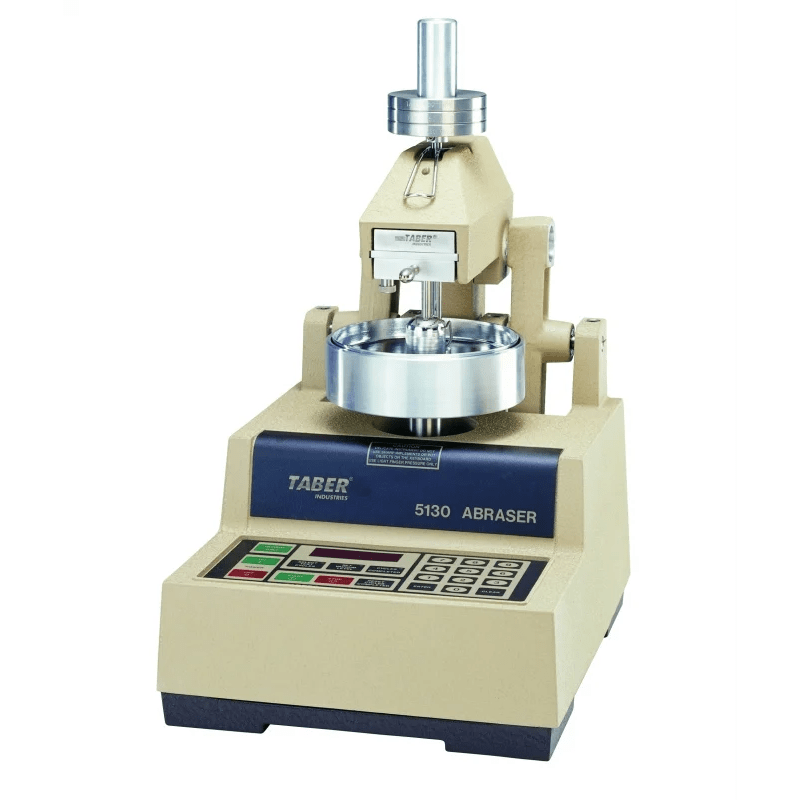
Taber Multi-Media Abraser 5500
Der TABER Multi-Media Abraser 5500 bietet ein reproduzierbares Verfahren zur Messung der relativen Abrasivität der meisten Flüssigkeiten, Pulver, Pasten und halbfesten Stoffe. In Verbindung mit dem Taber Rotary Abraser (Abrader) 1700/1750 ist der Multi-Media Abraser wertvoll, um zu charakterisieren, wie diese Medien Verschleiß verursachen, wenn sie mit verschiedenen Komponenten in Kontakt kommen.
Der Taber Multi- Medien Abraser ist NICHT MEHR ZUM KAUF VERFÜGBAR. Wenn Sie an diesem Gerät interessiert sind, kontaktieren Sie uns bitte.
The Multi-Media Abraser used in the Concept of sliding wear was initially used to evaluate different types of adhesive and sealant formulations. The wear observed in laboratory tests correlated well with the wear caused by various adhesive formulations on moving parts in pumps and other application equipment in automotive production. Further details of this study are summarised in the article "New Tests for Determining Adhesive Abrasivity" in the February 1997 issue of Adhesives, Sealants & Industry.
Description
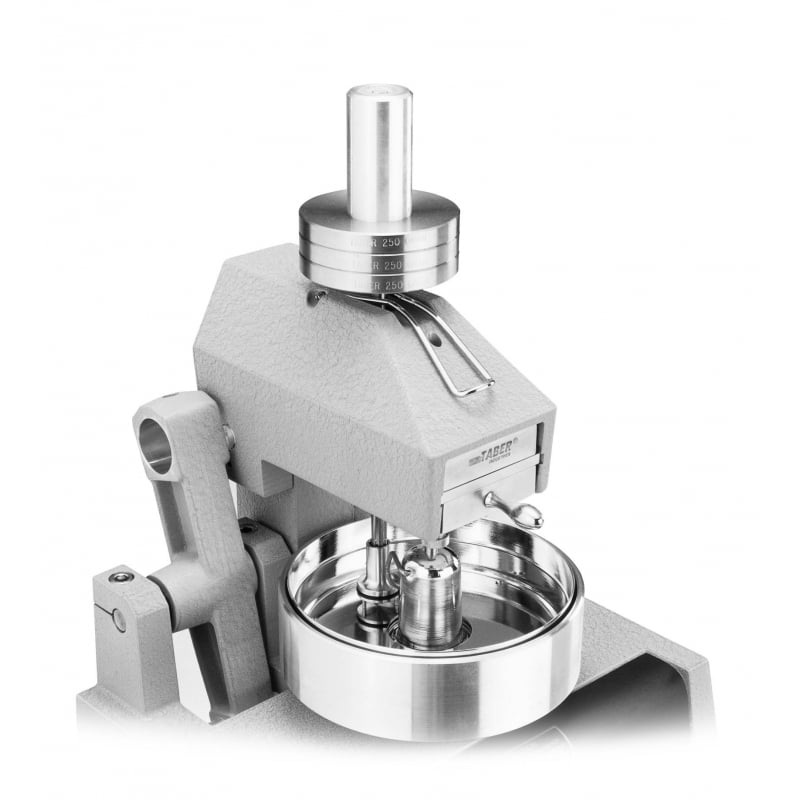
The medium to be tested is placed in a sample pan that contains a replaceable stainless steel wear disc at the bottom. As the bowl rotates, an integral drive shaft drives a series of gears that rotate the splined shaft. At the base of the shaft is a pin holder with three (3) replaceable high quality brass pins that rotate in the opposite direction of the sample cup. As the test medium flows between the brass pins and the stainless steel wear disc, the material acts as an abrasive and causes wear.
In order to test a wide range of material viscosities, both the load and the speed of the pin holder can be adjusted.
The standard test load on the brass pins can be varied from 250 g to 1,000 g (in 250 g increments with the weight discs supplied). The maximum load can be increased to 2,500 g with optional weight discs.
The rotation speed of the sample tray depends on the Taber Abraser model used. By changing the gearbox, the speed of the needle holder can be changed as shown in the table below. The more abrasive or viscous or the larger the particle size of a medium, the greater the resistance it presents to the system. A lower/slower drive speed should therefore be selected. The optional gearbox offers a wider range of test speeds and is recommended for sample loads of more than 1,750 g or with a low particle concentration in the medium.
For the sake of simplicity, the gearbox is colour-coded.
- Orange - Used for testing most materials.
- Yellow - Leads to a 23% increase in speed. Recommended to reduce the total number of test cycles, reduce the "liquid wave" in front of the rotating pin holder and flatten the medium as it passes the pin holder.
- Red - This optional gearbox offers a ratio of 0.6:1 and is the slowest speed available. When the sample load increases to 1750 g or more, it may be necessary to operate at a slower speed to ensure sufficient torque to rotate the pin holder and maintain a constant speed.
- Green - This optional gearbox offers a speed increase of 290 % compared to the standard gearbox arrangement. It is recommended when the particle concentration as a percentage of volume is low, the sample load is low and the wear rate may be insignificant over an extended number of cycles.

Customised pins or wear discs can be manufactured using the template included in the operating instructions. Using custom pins or discs made from the materials of your specific application will help you to understand the wear characteristics.
The Taber Multi-Media Abraser is available as a separate attachment (model 5500) or pre-mounted on a single or double Taber Abraser.
Evaluation
Measuring the weight loss of the brass pins enables an accurate comparison of the removal rates of different media. The pins can be used until 25 % of the original weight has been removed. At this point the pins should be replaced.
Note: Centrifugal effects can lead to decreasing wear rates as the number of cycles increases due to outward particle migration. If your fluid sample contains particles, shake or agitate the fluid so that it has a uniform consistency. Examine the liquid after 3 1/2 minutes; if the particles detach from the liquid, you may need to change the test parameters to account for the detachment. Possible parameter changes include: Inserting a "paddle" into the sample dish to redistribute the particles, changing the speed of the needle holder, etc.
Additional information
| brand | Taber |
|---|---|
| Mission | Laboratory |