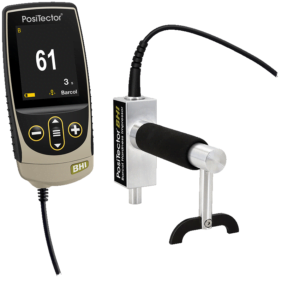
Your product
TQC Sheen Analogue Barcol Impressor Hardness Tester
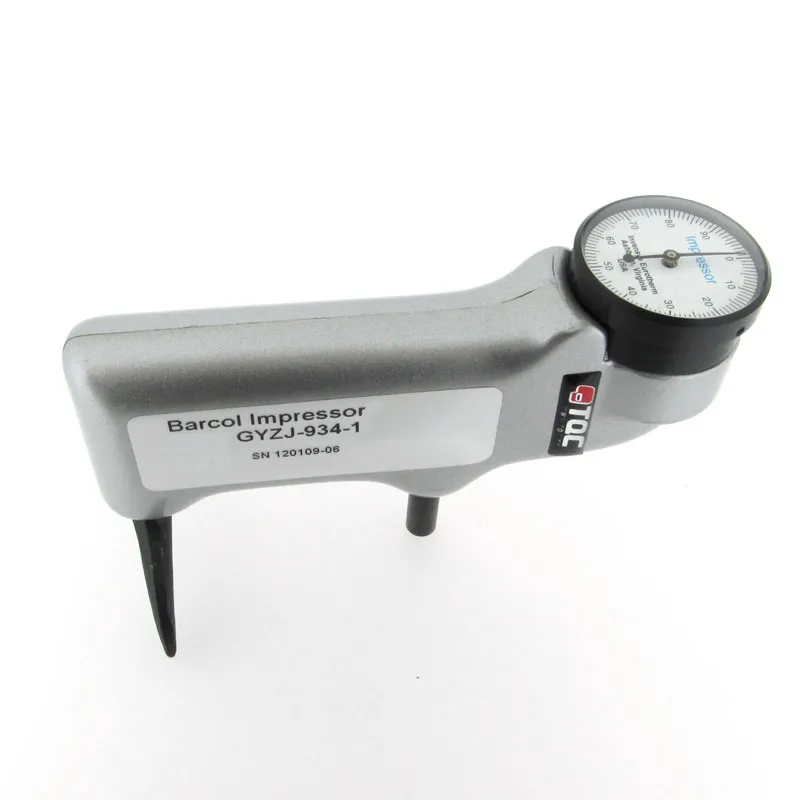
TQC Sheen Analogue Barcol Impressor Hardness Tester
The Barcol Impressor is a practical tool for testing the hardness of aluminium, aluminium alloys, copper, brass and other materials, including plastics and glass fibres.
Barcol-Impressor hardness tester VF6500 (GYZJ-934-1) für Metalle (Aluminium, Aluminiumlegierungen, Kupfer, Messing) und andere Materialien, einschliesslich harte Kunststoffe und Glasfasern. Das Gerät ist für den Einsatz an gefertigten Teilen und Baugruppen sowie an Rohmaterial konzipiert.Mit Umrechnungstabelle in Brinell, Vickers & Rockwell B, E, F, H.
Features & benefits
- The device is suitable for use on finished parts and assemblies as well as raw materials.
- No experience required; can be used in any position and in any place where the operator's hand has room. The hardness value is immediately displayed on the scale, which is divided into one hundred levels.
- No waiting, pretensioning or separate measurements.
- The Impressor weighs only 1 lb. 2 oz. The entire Impressor package comes complete with carrying case, adjustment spanner and two spare indenters.
- The impressor incl. case = 2 lb. 8 oz.
For testing of:
- Aluminium alloys
- Soft metals
- Plastics
- Fibreglass panels, tanks, surfaces
- Fire brigade ladders
- Composites
- Rubber or leather
- Laminates
- Lead
Barber-Colman: Barcol
Simple, portable device for testing the hardness of materials in accordance with ASTM D2583. Originally called the Barber-Colman-Impressor, the Barcol-Impressor was developed by Walter Colman during the Second World War as a portable hand-held device for assessing the hardness of a material. The United States Army Air Corps needed a handheld device to test the hardness of rivets because it feared that aircraft could be sabotaged by replacing normal rivets with soft lead or wooden rivets that would fail during flight. The pressure device works when the tip is pressed against the material in question. The hardness of the material determines the penetration depth of the point, which is transmitted via a tension spring and a lever and read on a scale.
The Barcol hardness test is generally used for soft materials such as hard plastics. It measures hardness based on the indentation of a point with a flat tip. The test is performed using a similar method and indenter to the Shore D hardness measurement, but the Shore D indenter has a round tip. Barcol hardness is not a valid hardness measure for curved surfaces.
Spare parts
- VF6505 Standard test disc (43-48)
- VF6506 Standard test disc (87-89)
Test procedure
When Pressure on the device is exercised, a tip penetrates the material and the Hardness level is displayed on a scale from 0 to 100.
The Impressor is best for the Suitable for testing homogeneous materials. In the case of materials with a granular, fibrous or coarse structure, the small diameter of the penetration point results in large fluctuations in hardness.
To obtain accurate measured values, the Material at least 0.8 mm (1 /32″) thick and be large enough to Minimum distance of a good 3 mm (1/8″) in each direction between the indenter and the edge of the sample to be guaranteed. The test area should Smooth and free from mechanical damage be.
Simply apply light pressure to the instrument to press the spring-loaded penetrator tip into the material. The indenter tip must be perpendicular to the surface to be tested. For very soft metals, the highest reading should be used as the cold flow allows the spring-loaded penetrator tip to penetrate further.
Note: Due to the physical properties of very soft materials, it is not possible to establish a standardised correlation between different hardness measurement systems. We recommend determining the indentation hardness limits for each material by carrying out tests.
Additional information
| brand | TQC Sheen |
|---|---|
| Mission | Coating test, hardness test |
| Industry sectors | !!! Painters Coaters Printers |
| Substrates/substances | Faserverbundwerkstoffe, Kupfer, Messing, Verbundwerkstoffe, Kunststoffe und Polymere, Aluminium |
| Standards | ASTM D2583 |