Your product
Taber Webbing Abrasion Tester 5820
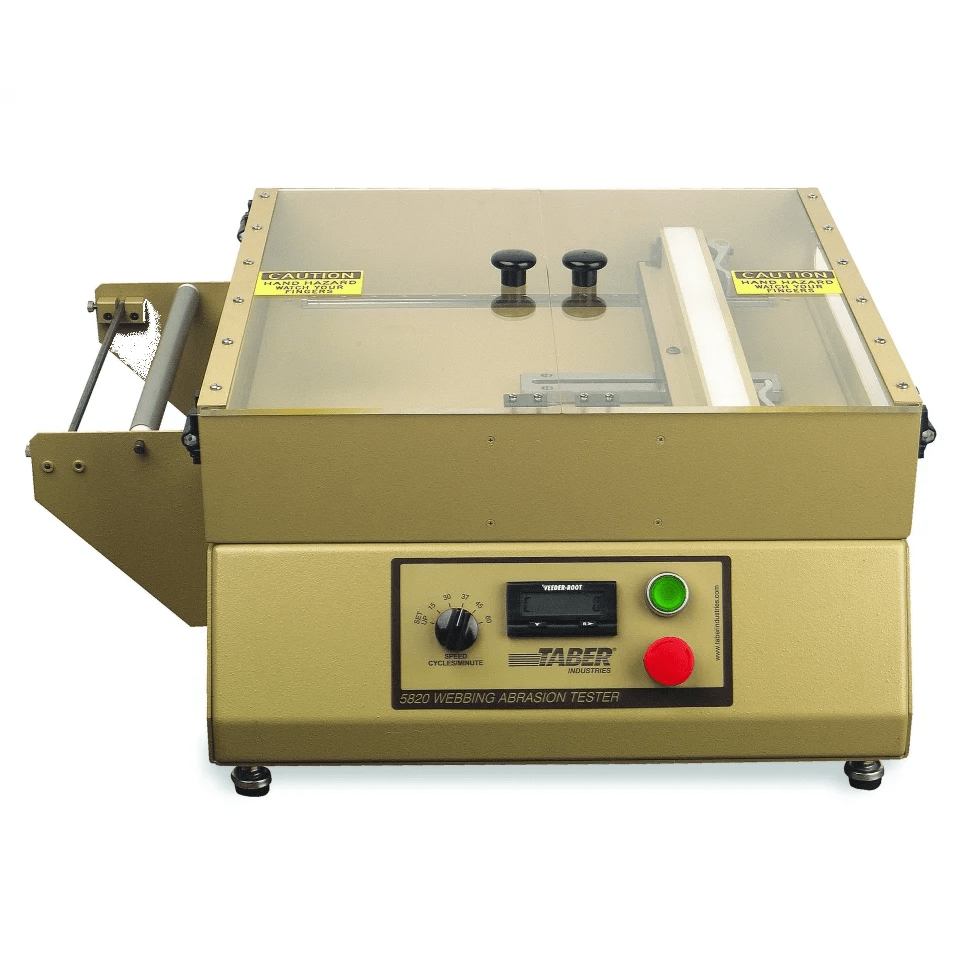
Taber Webbing Abrasion Tester 5820
Das Gurtband-Abriebprüfgerät TABER Webbing Abrasion Tester 5820 wird zur Bewertung der Abriebfestigkeit von Sicherheitsgurten und anderen Gurtbandprodukten (z. B. Sicherheitsgurte, Haltegurte, Hosenträgergurte, Helmgurte usw.) verwendet. Zu den gängigen Materialien, die mit diesem Gerät geprüft werden können, gehören Nylon, Polyester, Leder, Polymere und andere flexible Folienmaterialien.
A sample clamping bar secures the sample to the device, while a sample roller ensures that an angle of 85° (±2°) is maintained between the sample and the hexagonal scraper bar. The sample is weighted and then subjected to unidirectional reciprocating friction as it is moved back and forth across the hexagonal abrasive strip. During each test, the sample passes over two of the six abrasive edges of the 12-inch hexagonal abrasive strip.
Depending on sample width, up to three samples can be tested simultaneously. Other features of the Taber Webbing Abrasion Tester include a slotted roller channel that allows for a maximum stroke length adjustment of 12 inches (305 mm), five preset speeds including 15, 30, 37, 45 and 60 cycles per minute, a hinged transparent safety cover and a standard weight set of 2, 4 and 5.2 pounds (an optional weight set of 3 and 5 pounds is also available).
The Webbing abrasion tester 5820 materials with a Test breaking strength of over 13,500 N in accordance with ASTM D6770, MIL-W-23223B, US Department of Transportation FMCSA Part 571.209 and other internationally recognised test standards.
Abradants (scouring agents)
Two (2) fresh edges of the abrasive strip should be used for each test. If only one sample is tested at a time, the next sample can be ground on a different part of the hexagonal abrasive strip. Once the entire length of the bar has been utilised, it must be rotated to expose two (2) new edges. Once the entire surface has been utilised, the hexagonal sanding strip should be discarded and replaced.
Evaluation
The most common method for evaluating the abrasion resistance of webbing material is to use a CRE-type tensile testing machine equipped with split-drum webbing clamps as described in Federal Test Method 191b, Method 4108.
- Average Breaking Strength - For each sample batch, the average breaking strength should be calculated for both the abraded (A) and unabraded (U) batches. The average breaking strength is determined by adding the breaking strength of each individual sample and then dividing by the total number of samples in the batch.
- Abrasion resistance (AR) - Abrasion resistance is the percentage of the breaking force obtained after abrasion. Abrasion resistance can be determined using the following formula:
AR = 100 (A / U)
wobei- AR = Abriebfestigkeit (%)
- A = average breaking force of the abraded sample, N (lb)
- U = average breaking force of the unground sample, N (lb)
Additional information
| brand | Taber |
|---|---|
| Standards | ASTM D6770, Federal Test Method Std. No. 191A Method 5309, FMVSS 209 (§ 571.209), MIL-T-8363B, MIL-W-23223B, MIL-W-4088K |
| Substrates/substances | Leder, Textil |
| Mission | Laboratory |